
"True yoga is not about the shape of your body, but the shape of your life. Yoga is not to be performed; yoga is to be lived." — Aadil Palkhivala
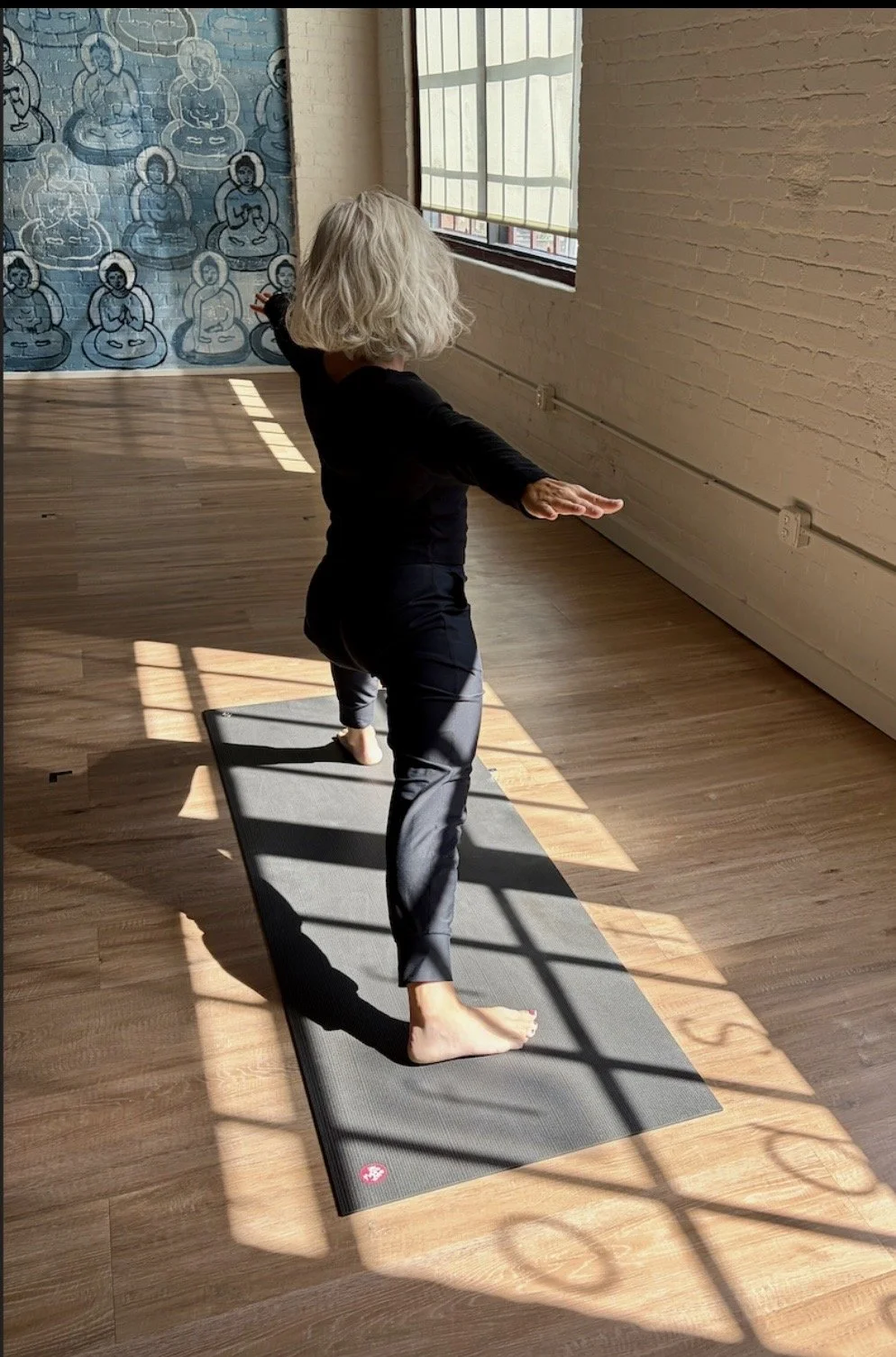
For many people, especially those new to yoga, it can be uncomfortable to practice yoga in a studio setting. Instead of dropping into the practice, people may find themselves distracted by self-consciousness, self-doubt, and a feeling of not belonging. It can feel like there’s a secret language being spoken that everyone but you understands—not just the Sanskrit words for poses, but the etiquette, the poses, the interaction with other people. This was certainly the case for me.
My big sister introduced me to yoga when I was a teenager, but I didn’t start practicing regularly in studios until I was in my thirties. I found that, during my practice, I was more focused on my inner monologue—my busy mind—than on the actual yoga. It wasn’t until I found a studio where I felt safe enough to confront these insecurities (spoiler alert: it was Yoga Off East) that I started to learn what was on the other side of those insecurities and fears: a joyful love for movement and a deep desire to learn more about this ancient practice. Ultimately, it was facing and embracing those insecurities that led me to a deeper personal practice and teaching.
This got me thinking about my off-the-mat yoga practice, and how it’s often informed by what comes up for me on the mat.
As anyone who’s taken a yoga class knows, it’s not uncommon for unpleasant sensations to come up when we’re on the mat. Insecurity is a common one, but you may also experience self-doubt, boredom, comparison, even grief. It’s important to know that there’s a place for all of this in your asana (physical yoga) practice. Rather than avoid these feelings, we can embrace them and get curious about what they’re trying to tell us. In Taking the Leap: Freeing Ourselves from Old Habits and Fears, Pema Chodron writes, “Instead of getting better and better at avoiding, we can learn to accept the present moment as if you had invited it, and work with it instead of against it, making it our ally rather than our enemy."
Accepting unpleasant sensations and being present for them without trying to push them away is the essence of santosha (the second tenant of the niyamas, the second limb of yoga). Santosha is often interpreted as gratitude, but it’s not always that simple. Its literal translation is complete satisfaction or total contentment, no matter what. The “no matter what” is not a literal translation, but an implied one. Santosha, and in fact our entire asana practice, invites us into acceptance of whatever arises in each moment, the good, the bad, and the ugly.
For most of us, asana (the physical practice) is the limb of yoga we’re most familiar with, so it makes sense that the mat is an accessible path into practicing the other limbs of yoga. In this way, the mat becomes a mirror, reflecting back what we most need to learn. The things that come up for us on the mat are often guideposts, directing us towards not just a deeper practice, but also a deeper experience of living. In this way, the mat is also like a doorway into exploring the full scope of our yoga practice.
Here are some examples of the ways in which my on-the-mat practice have enriched and instructed my life off the mat:
Using the breath as an anchor to the present moment throughout my asana practice—breath after breath, class after class— has helped me remember to use breath as a tool for finding calm during stressful moments in traffic or interacting with difficult people or situations. This is the fourth limb of yoga: pranayama, or breath.
Withdrawing my attention from the outside world and focusing intensely on a single, challenging pose has helped me to to strengthen the mental and spiritual muscles that allow me to stick with stillness during meditation or, in my writing practice, to block out distractions and focus intensely on finishing a chapter or a scene. This conscious withdrawal from the external senses to turn inward is the fifth limb of yoga, pratayahara.
Noticing that I was highly critical of myself and easily dropped into comparison mode during group yoga practices ultimately became, for me, an invitation to the practice of self-compassion. This is the first tenant of the first limb of yoga, the yamas: ahimsa, or non-violence against ourselves and others.
As Rolf Gates shares in Mediations from the Mat, “The real payoff of a yoga practice … is not a perfect handstand or a deeper forward bend—it is the newly born self that each day steps off the yoga mat and back into life.” The same way that you can hit a pose perfectly one day and not be able to do it at all the next, these lessons we carry off the mat are ever-evolving, non-linear. So, be patient with yourself as you explore new aspects of your practice.
The next time you step onto your mat, be curious about what arises there. Embrace the joyful moments on the mat, and when uncomfortable moments arise, ask yourself if there’s a lesson there. In this way, the mat is also an invitation into a richer, more meaningful life.
To practice with Kate, sign up for one her classes at Yoga Off East. To read more of Kate’s writing, follow her at Midlife Sentences (on Substack).