
Flow Study: Samadhi - Returning to Our Original State by Kathryn Smith
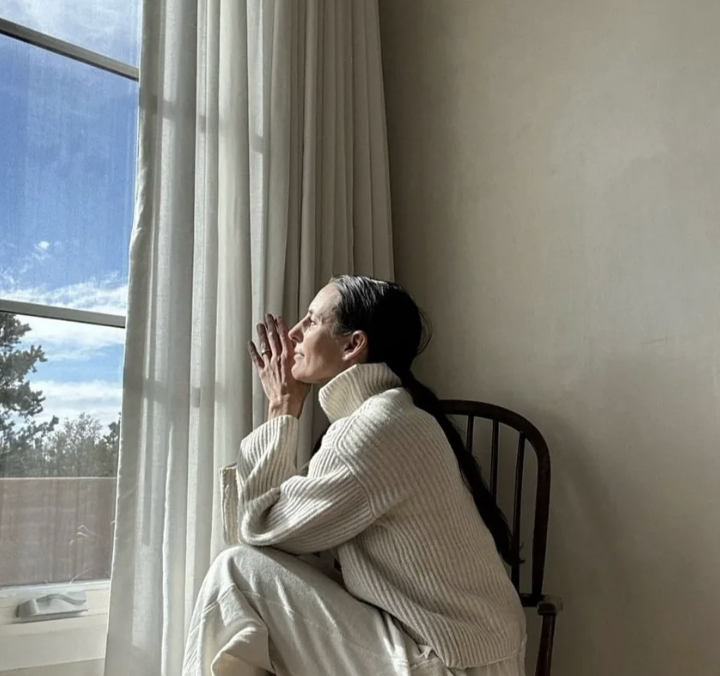
Austin, TX-based yoga teacher and writer, Kate Waitzkin
Over the past year, Flow Study has taken us through the eight limbs of yoga, one month at a time. We’ve explored the yamas and niyamas as ways of relating to ourselves, one another, and the world around us; moved through asana and pranayama; and turned inward through pratyahara, dharana, and dhyana.
Now, we arrive at the eighth and final limb: samadhi.
Of all the limbs, samadhi may be the hardest to put into words. It is often translated as absorption, and in Patanjali’s Yoga Sutras, it’s described as a deep meditative state in which the usual distinction between the meditator, the act of meditation, and the object of meditation begins to dissolve. Often I wonder, “Is samadhi attainable?” and I also think of it as a flow state, an inner stability that cannot be disturbed, demonstrated by athletes, artists, writers, and performers when they are completely immersed in their craft. The concept of Samadhi is a deepening of the inward focus we explored through dharana and dhyana.
Rather than approaching samadhi as an extraordinary state reserved for an enlightened few, let’s consider it another way: What if the ultimate purpose of yoga is not to arrive somewhere new or different, but to remember what is already here? An unlearning more than the pursuit of something that feels out of reach for most of us.
I found a compelling connection here to a recent piece by my friend, Kate Waitzkin, an Austin, TX-based yoga and meditation teacher, writer, and over the years, a guest teacher at Yoga Off East.
In her Substack article “your original state: on renewal and returning,” Kate explores the word renewal and arrives at a simple idea: renewal isn’t necessarily about creating a new version of ourselves. It can be understood as a return, a restoring of something that was here all along.
She connects this idea to one of the foundational teachings of the Yoga Sutras: yogaś citta-vṛtti-nirodhaḥ (the quieting or stilling of the fluctuations of the mind) and what follows: tadā draṣṭuḥ svarūpe ’vasthānam (often translated as “then the seer abides in its own true nature.”) Kate describes this as the possibility of softening our identification with the stories, patterns, and emotions that continually move through us, allowing something steadier and more essential to become visible.
This feels like a fitting way to approach our final limb. The eight limbs aren’t a checklist or a ladder to climb toward something outside ourselves. They can be understood as practices that gradually turn our attention inward—helping us cultivate steadiness, awareness, discernment, and presence. And maybe samadhi isn’t so much about arriving somewhere as it is about what emerges when we stop grasping, engaging, and identifying with every thought that passes through.
With that in mind, we’re doing something a little different for this month’s Flow Study. Rather than offering our own teacher-written reflection, we’re sharing Kate’s piece in its entirety as an invitation to contemplate samadhi through a more personal lens.
As you read, notice what resonates—not as a concept to understand perfectly, but as an invitation to notice your own experience.
I hope Kate’s words invite you to pause, reflect, and recognize something within that has been here all along.
Read Kate’s essay, “your original state: on renewal and returning,” below.
On a sun-drenched afternoon in late March, I settled into a seat on the living room floor in the home of a dear friend. This gesture marked the beginning of a yoga and meditation retreat I had been asked to guide for a group of deeply inspiring women devoted to practice, personal growth, and genuine connection with the world around them.
The woven blanket beneath me, folded with care and placed at the center of my yoga mat, offered a familiar sense of reverence and support. I slowly opened my notebook to reveal worn pages cloaked in my handwriting. Filling the pages were shorthand notes, class plans, carefully selected throughlines and quotes, sketches of stick figures in yoga postures, and bulleted prompts for journaling. These visuals instantly grounded me in the truth and knowing that I was well prepared for our time together. The varying shades of ink and graphite spread across the pages served as a reminder that my work in this moment was to let go and trust the unfolding of the group gathering together, one by one. We silently formed a circle, our eyes met, and everything softened.
The theme of the retreat had been set early on by the hosts. A single word, fairly common in the lexicon of wellness experiences. A term that, at first glance, suggests one thing, yet with a touch of curiosity and exploration begins to reveal something altogether different and ultimately perfect for the purpose and intention of our time together. The word was RENEWAL.
As I often do when working with a theme for a retreat, I began unpacking the word, seeking pathways to weave its meaning into our practices. Initially what I noticed is that dropped right into the center of renewal sat the word new, a term defined as not existing before; discovered for the first time. But when I started digging into the various definitions of renewal (or renew), what I found was quite the opposite:
Renew: to restore ( > restore: to bring back to a former or original state)
Renew: to revive
Renew: to reestablish or begin again
As my eyes drank in the assorted definitions of this word, a term I’d previously understood as one thing and now held a new appreciation for and relationship with, I couldn’t help but smile as the pieces of the puzzle began to click into place.
Based on these descriptions, renewal is not about newness, cultivating or becoming something we are not (already). It is not so much a rebirth or reinvention as it sometimes suggests, rather renewal can be considered a process of a returning, a returning to or restoring of our original state, an understanding and embodiment of ourselves that has been present all along.
The Yoga Sutras (philosophical text of classical yoga) define yoga as a stilling or softening of the turnings / fluctuations of the mind stuff : citta (mind stuff) vritti (turnings or fluctuations) nirodha (quieting, cessation).
This is followed by quite possibly my favorite teaching of the sutras: Then we abide in our true (essential) nature : (Tadā draṣṭuḥ svarūpe’vasthānam).
In other words, when we are able to see / bring into light / observe the layers upon layers of story or narrative playing in our minds at any given moment (how human of us), the beliefs, emotions, identities, patterns, the armor we’ve built around ourselves, aspects of our lived experience that are in a constant state of change, we also begin to reveal a doorway into the heart of who and what we really are.
When the citta (mind stuff) has space to soften, when we begin to see and understand that we are not that, but we are the one observing that, we naturally cultivate the conditions within ourselves to begin to remember our true nature, the inherent steadiness, the innate ease, the deep abiding presence and wholeness, our original state.
And when we interface with this aspect of our being in some consistent way through practices of our own choosing (asana, meditation, prayer, journaling, art, nature, etc), we open ourselves to the possibility of our essential nature becoming more familiar, more available, more reliable than the change that swirls within us and around us.
What I gathered through this exploration of a single word, one I thought I understood clearly, is that renewal is not additive. Renewal is not the procurement or cultivation of a new version of ourselves, one that did not previously exist. At its core, and through this lens of practice, renewal is a process of revealing, remembering, and returning to our original state, a journey back home to ourselves.
A few prompts to explore:
When do you feel most yourself, most at ease? What does this feel like in body and mind?
What practices, rhythms, or rituals are supporting you? What do you notice about their impact?
What patterns are you engaging in that move you away from yourself / that leave you feeling disconnected?
Is there something in your life that you feel ready to shed or release that may reveal a more aligned state or lived experience for you?
What do you notice, observe, hear in moments of stillness?
What meaning does renewal hold in your life right now? How might a practice of renewal support you?